Embracing uv⚡️
Python’s ecosystem has grown exponentially over the years, and with it, the complexity of managing Python projects has increased. From handling dependencies and virtual environments to ensuring reproducible builds, project management has become a crucial skill for Python developers. The challenge isn’t just about writing code anymore—it’s about organizing it in a way that’s maintainable, scalable, and easily shareable with others.
For years, the Python community has relied on various tools and approaches to tackle these challenges. Some developers swear by pip and venv, others prefer the more modern approach of poetry, while some opt for conda environments. Each tool has its strengths, but this diversity has also led to fragmentation in the ecosystem. What we’ve been missing is a unified, efficient solution that combines the best of all worlds.
The Balance 🤔
Being open towards learning new things (in my world often techs), often comes along with pros and cons. Depending on your level of experience and how many hours you have spent already with software, tools and methods. On the one hand, when you are well experienced and hardened your skills for a while, short-term it may seem counterproductive and frustrating to apply new techs. You have to spend your valuable time to learn them before they help you to get more productive. On the other hand though, when you are a rookie in a field of technology, you have the chance to check what’s out there and learn to work with the rising stars. They become your modern, default tech stack.
To me, the go-to lies somewhere in between. Trying to find the balance with using solid, proven tools and embracing new progressive techs is the goal.
Why uv? ✅
Since uv was released and all across my newsfeed I knew I want to try it. And I’m happy I did!
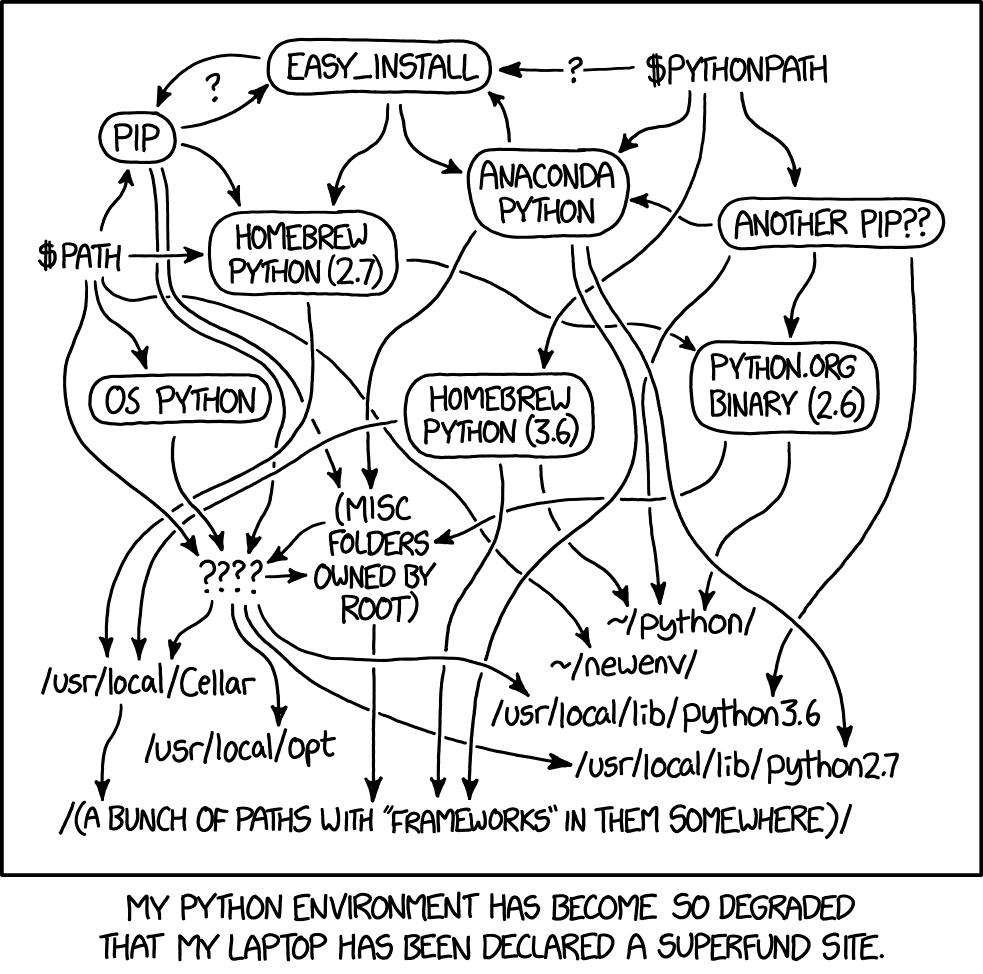
Managing Python packages can be done in many different ways and when you don’t know what you are doing very confusing (see hero image). Yet for modern development it is super important to have a clean Python setup as a solid base for clean codebases and project structures. Following standards using virtual environments efficiently is key. uv is here to help: As a single tool to replace tools like pip, poetry and virtualenv (to only name a few), it logs and organizes your projects Python versions and packages fully automated. Since it’s written in Rust it is impressively fast - everyone who worked with pip before will feel the difference, even in small-scale projects.
Getting Started ✨
It is well documented and, what I really like, it even provides a pip-compatible interface for pip users, which means: If you need a gradual migration to uv without changing your existing workflows, here you are! It is easy to install and fast to implement.
In A Nutshell 🎯
The Python community has been particularly excited about several key aspects of uv:
-
Blazing Fast Performance 🚀 - Being written in Rust,
uvis 10-100x faster than traditional package managers. Installing packages with a warm cache can be up to 115x faster than using traditional tools! -
Universal Cache System 💾 -
uvimplements a clever global module cache that avoids re-downloading and re-building dependencies. It uses Copy-on-Write and hardlinks on supported filesystems to minimize disk space usage. -
Drop-in Compatibility 🔄 - If you’re already using
piporpip-tools, you can start usinguvimmediately without changing your workflows. Commands likeuv pip installanduv pip compiledirectly map to theirpipequivalents. -
All-in-One Solution 🎯 - One binary replaces multiple tools:
pip,pip-tools,virtualenv, and more. No more juggling between different package managers and virtual environment tools.
Resources 📚
Here are some resources I have used to get an impression before using it:
- Python Tutorial: UV - A Faster, All-in-One Package Manager to Replace Pip and Venv
- Stop Using Pip - This New Tool is 100x Faster (UV Tutorial)
Final Thoughts 🎉
I will definitely stick with it for my future projects. Happy Packaging! 🎉